

Blood bank operations
HemoDesk — Blood Bank Software
Every bag from donor to patient, screened, tracked and issued — with a QR on the slip that anyone can verify on your website.
- Status Live deployment
- Screens shown 9 real captures
- Built with Node.js · SQLite · Runs on your own PC + LAN counters
- 5 screening tests recorded on every bag
- 8 blood groups on the live stock board
- 5 user roles, each with its own permissions
- 0 internet needed to issue blood
HemoDesk is blood bank software we built for a working blood bank and laboratory in Karachi. It runs on the centre’s own computer, other counters connect over the local network, and it keeps working when the internet does not.
A bag cannot skip a step
Every unit moves through the same chain — donor, collection, screening, grouping, components, stock, cross-match, issue — and the software refuses to skip a link. A unit with a reactive screen goes to discard, not to the shelf. Issued blood can never be deleted; an issue can only be cancelled with a reason, and the units are returned or discarded on the record.
Slips that cannot be forged
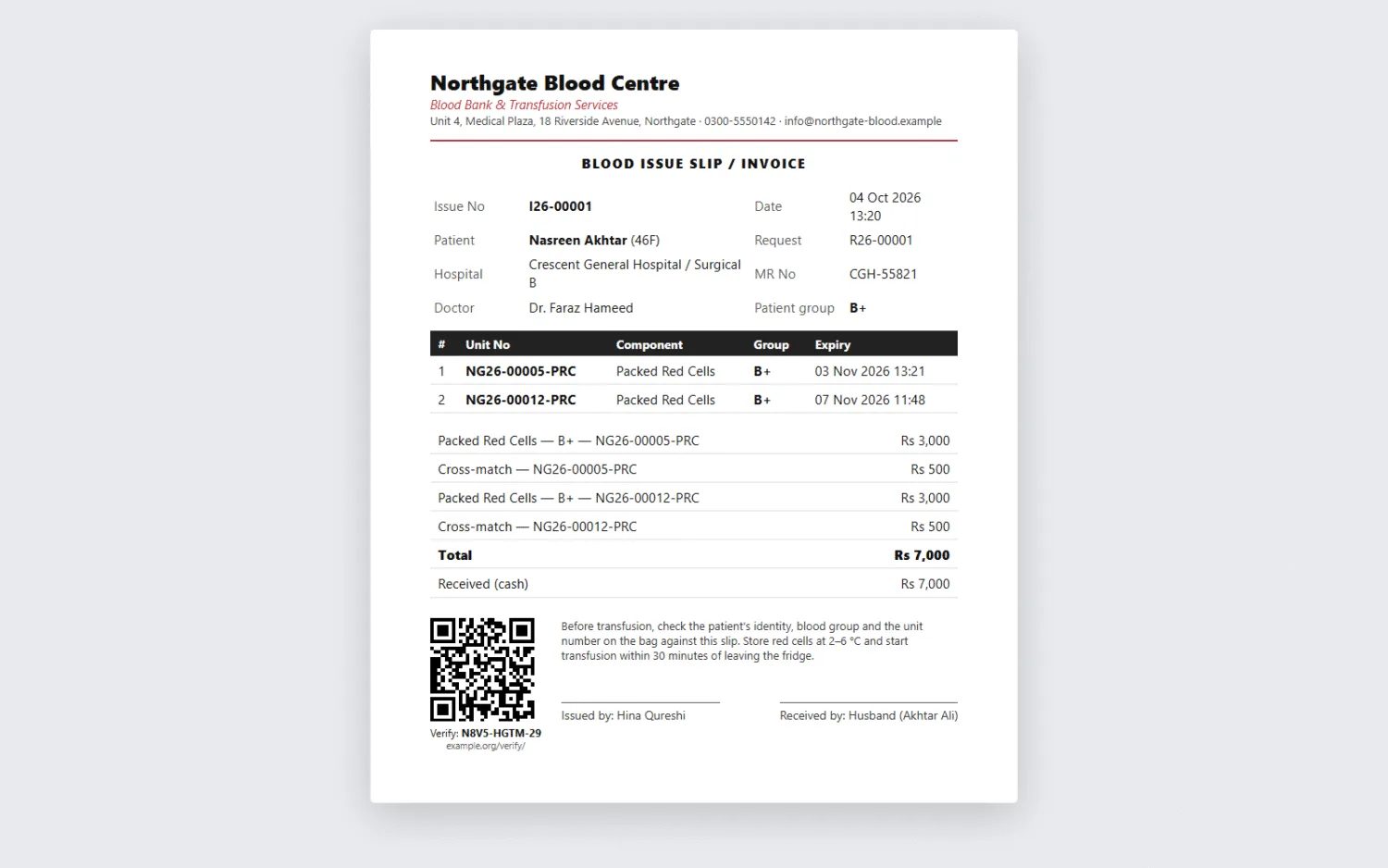
Each issue slip carries a QR code. Scanning it opens a verification page on the blood bank’s own website, which confirms the slip is genuine — or shows that it was cancelled. The website receives only a signed, minimal record, with the patient’s name masked.
Can we set it up for your blood bank?
Yes — the system is ours and is licensed monthly per centre. The name, logo, screening rules and rates are all set from Settings, so a new centre is an installation and a training session, not a development project.
The real thing
Every screen below is the running software
Captured from a working instance loaded with demonstration data — no mock-ups, and no customer records.

-
01
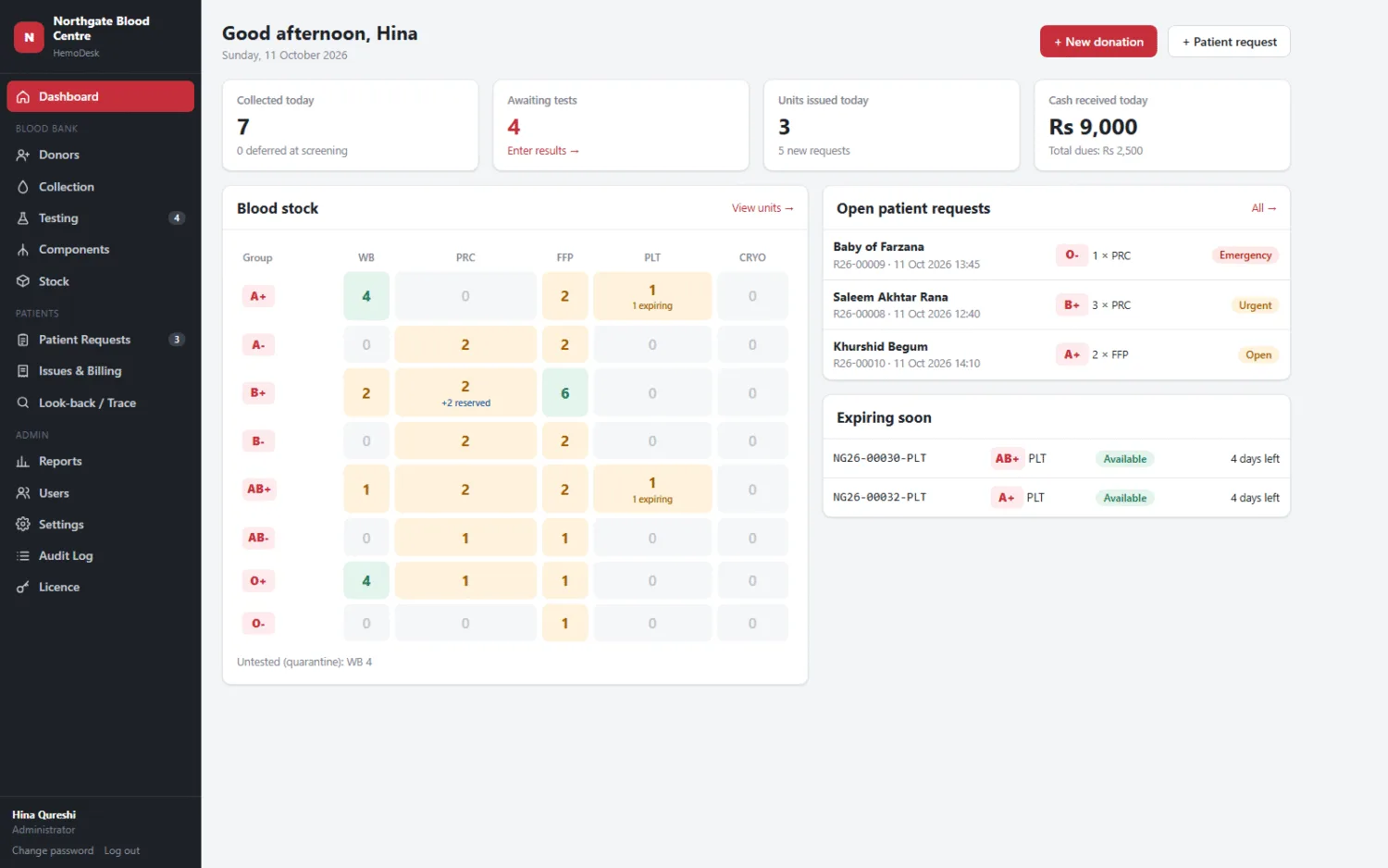
Dashboard
Today’s collections, bags awaiting tests, units issued and cash received — with live stock by group and component, open requests and units about to expire.
-
02
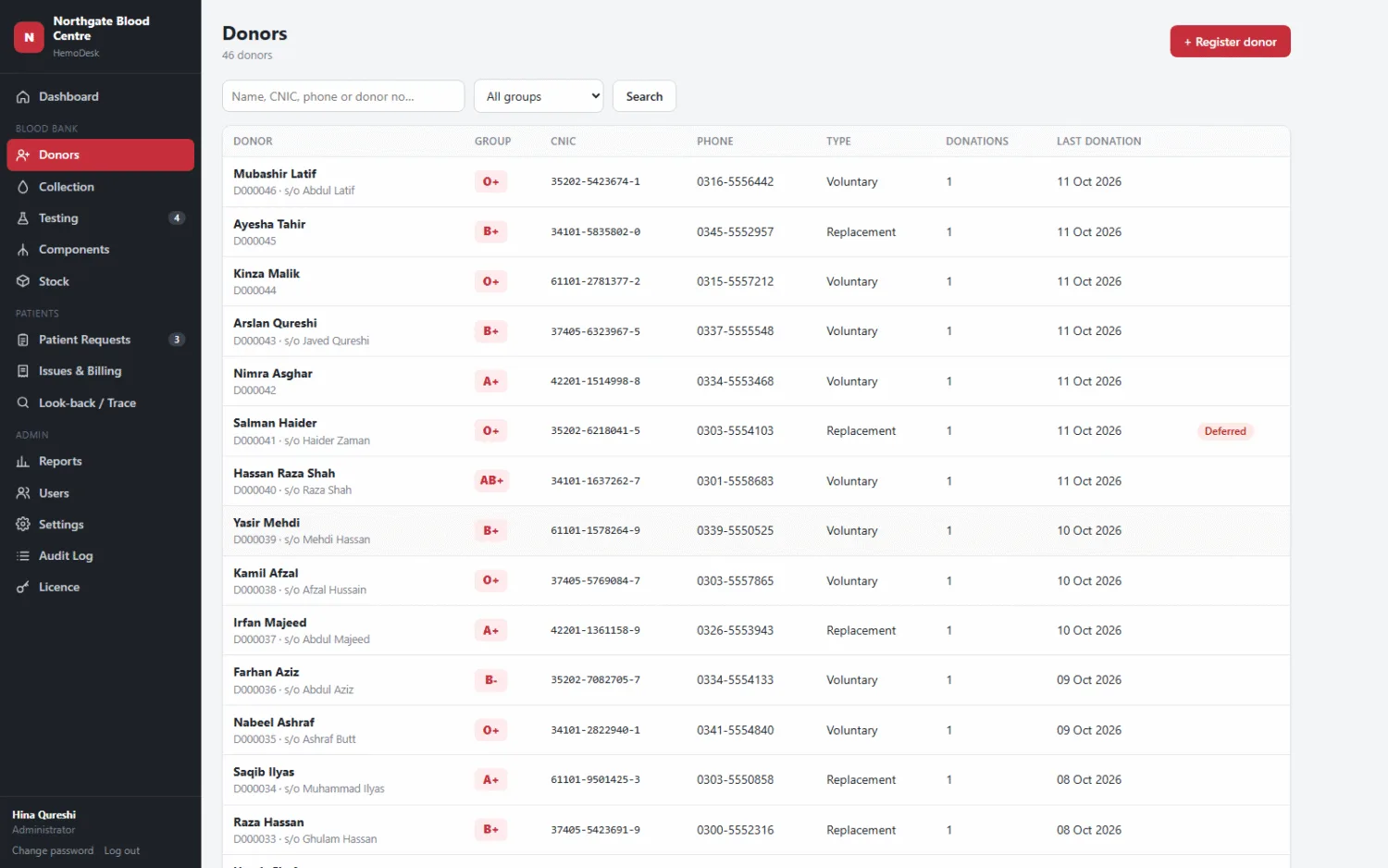
Donor register
Every donor with group, CNIC, phone, voluntary or replacement, donation count and last donation — deferred donors flagged.
-
03
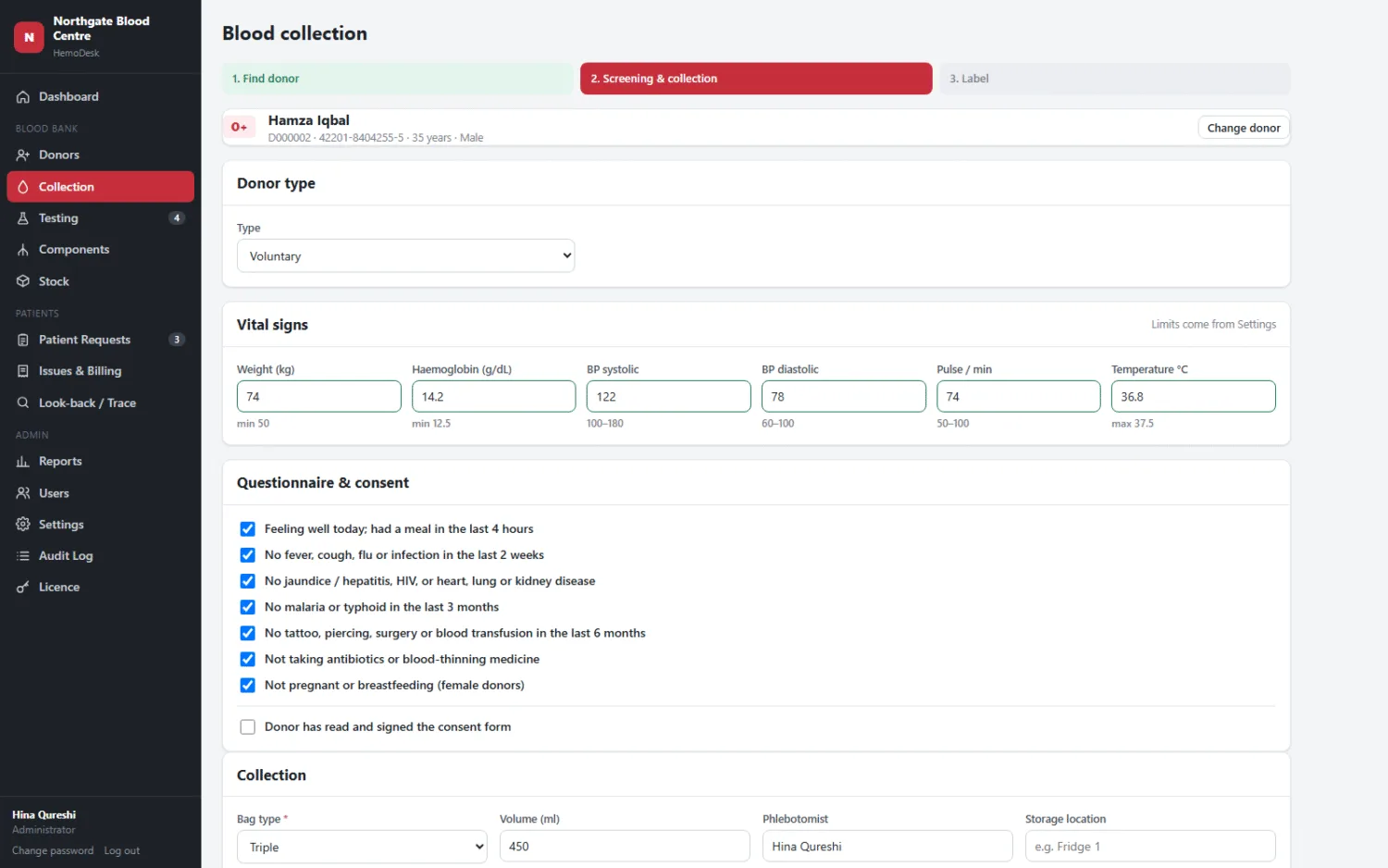
Collection
A three-step wizard: find the donor, record vitals against their limits and the health questionnaire, then label the bag.
-
04
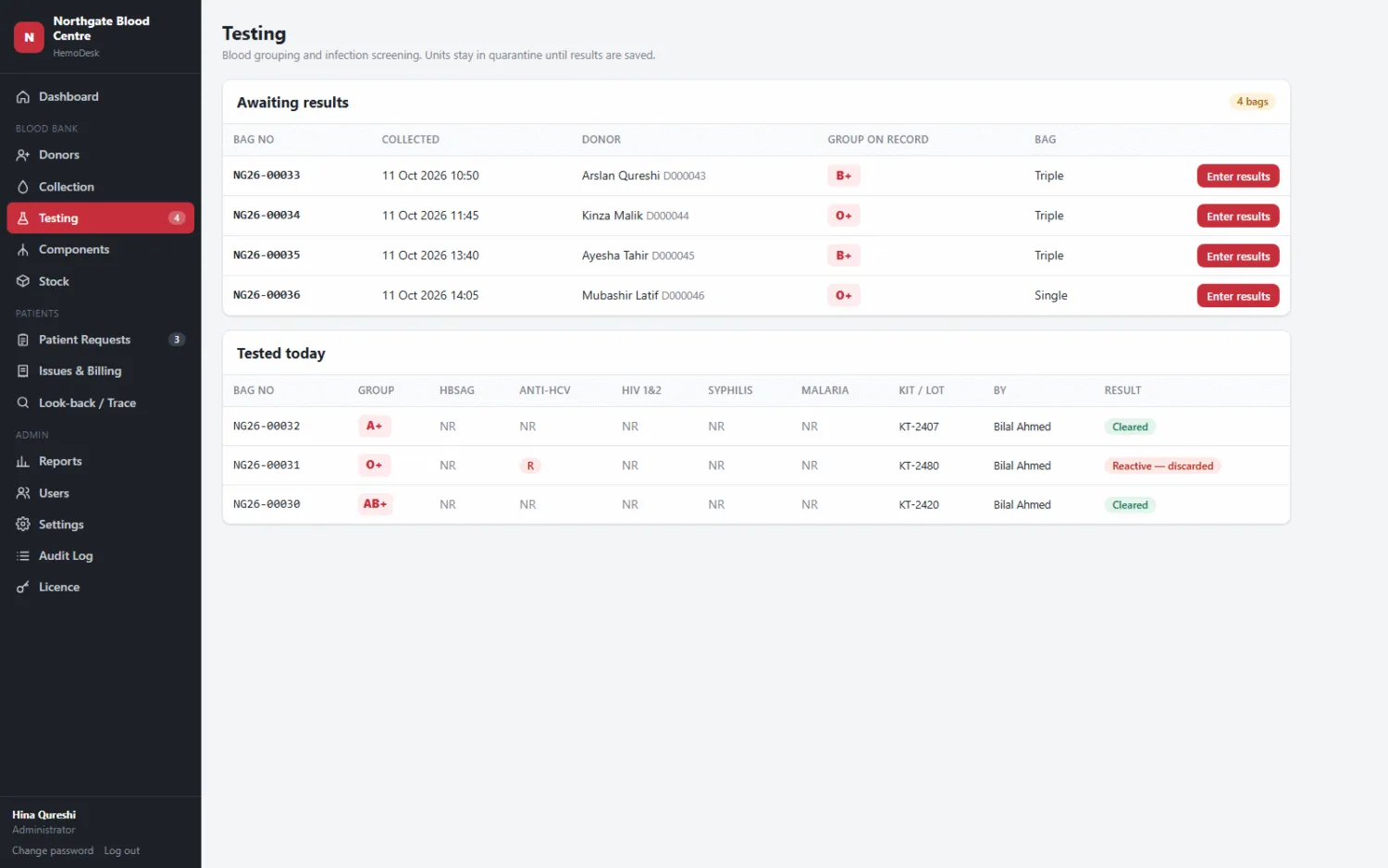
Screening & grouping
Quarantined bags wait for results. HBsAg, Anti-HCV, HIV, syphilis and malaria with kit lot and technician — a reactive bag is discarded, never stocked.
-
05
Blood stock
Units by group and component, filterable down to the bag, with days left before expiry.
-
06
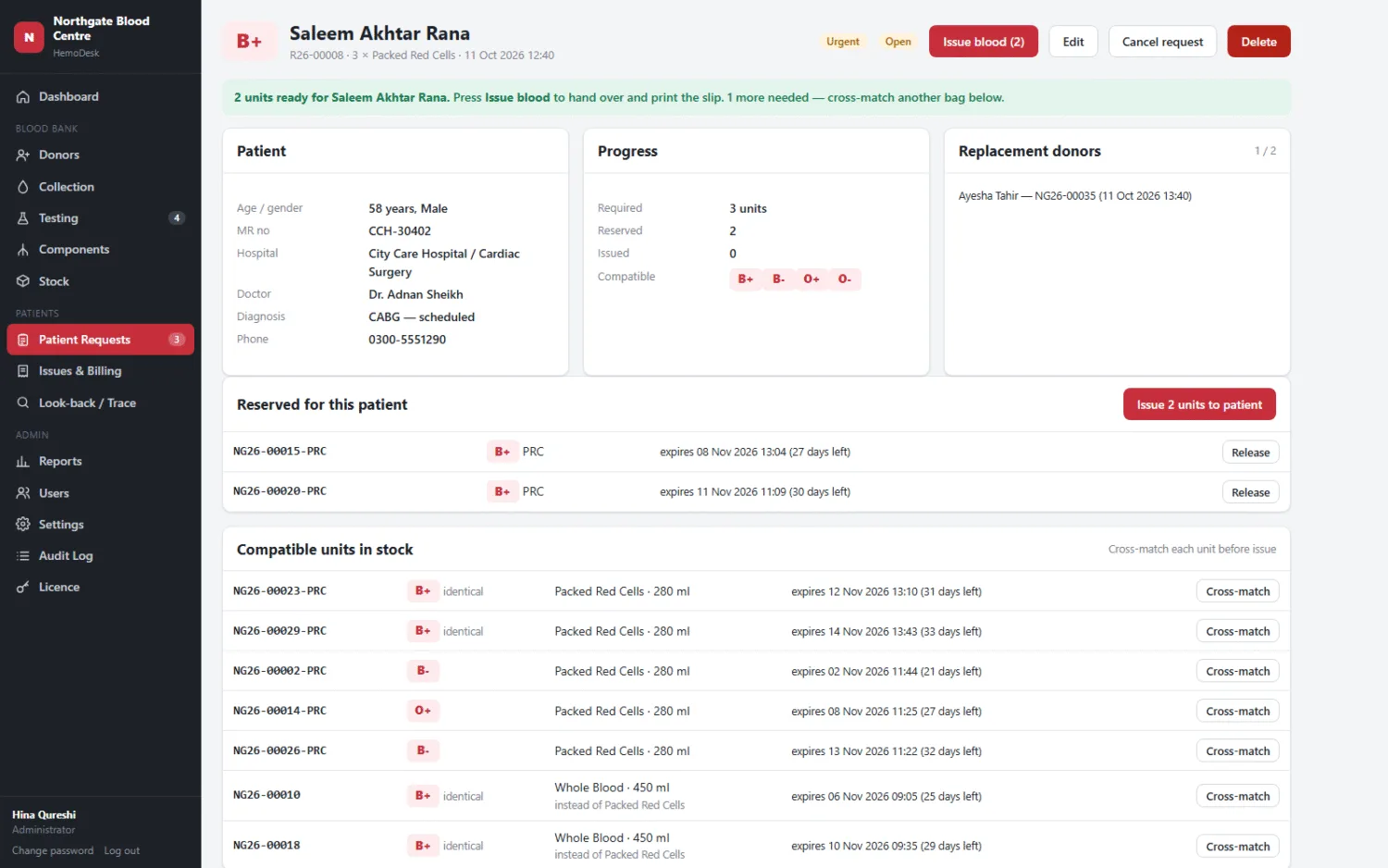
Patient request & cross-match
Compatible groups worked out for the patient, replacement donors tracked, and cross-matched units reserved before they are issued.
-
07
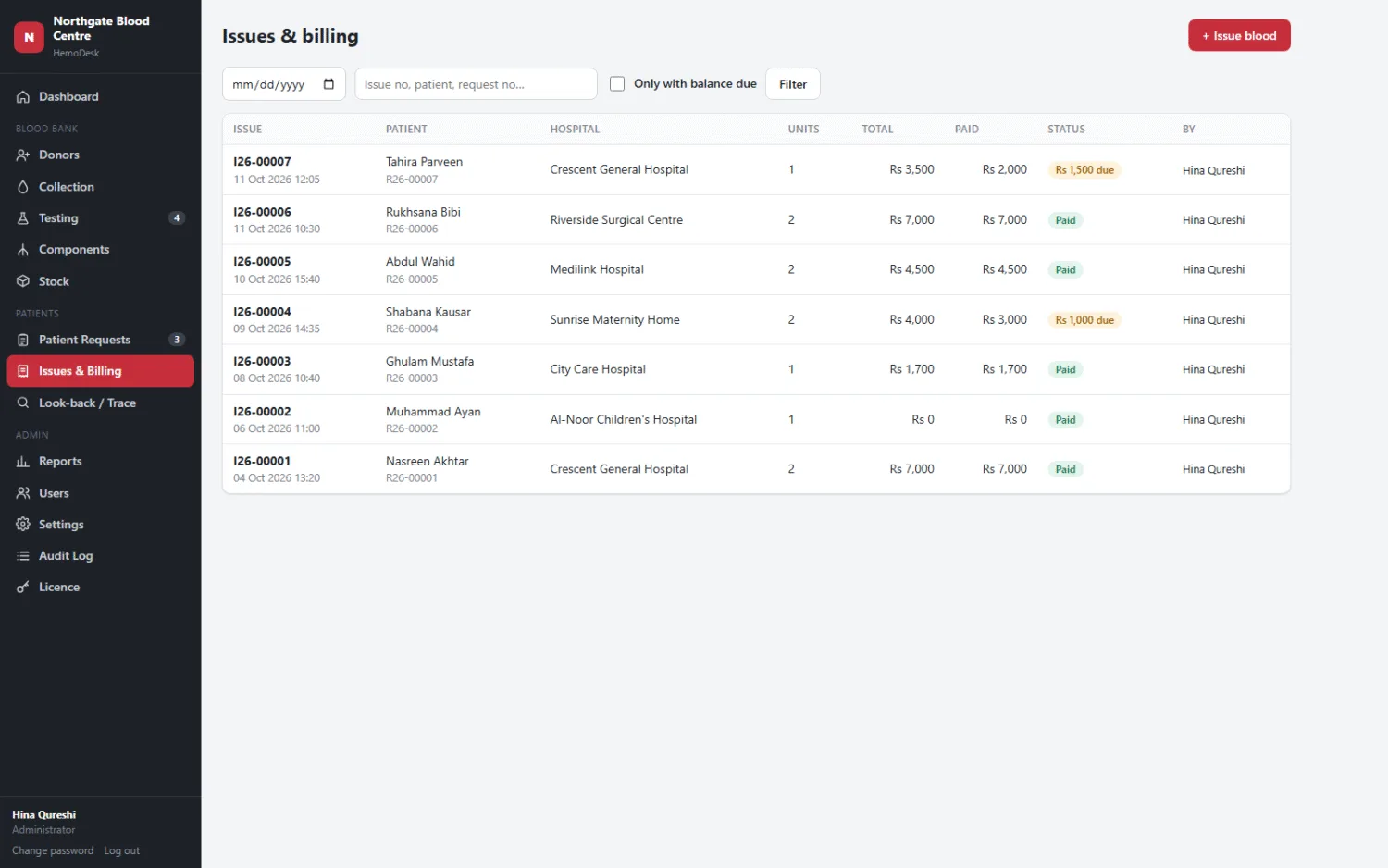
Issues & billing
Every issue with its total, what was paid and what is still due — normal, replacement-donor and free/welfare charges.
-
08
Issue slip with QR
The printed slip and invoice. Its QR code opens the blood bank’s own website and confirms the slip is genuine.
-
09
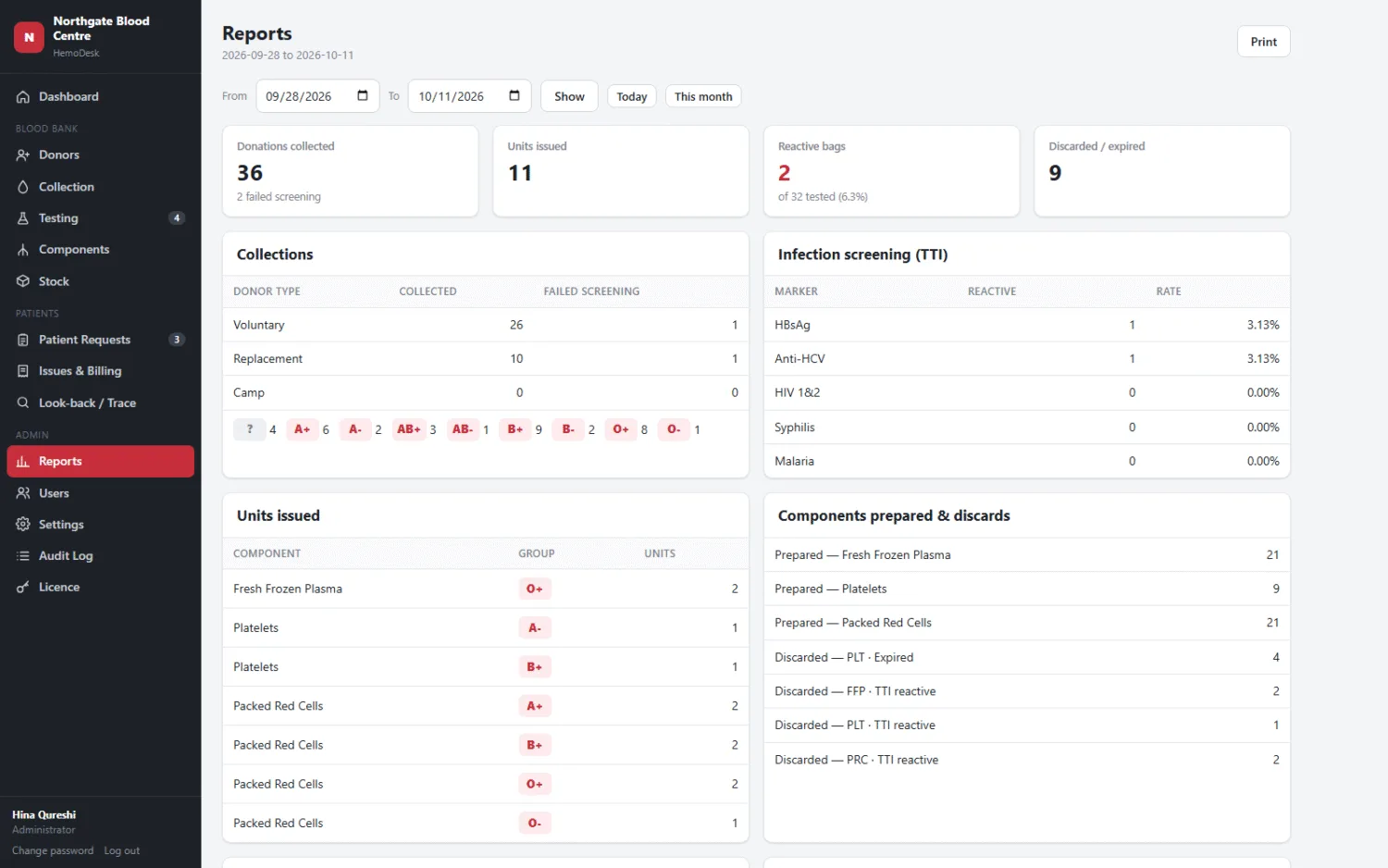
Reports
Collections, screening rates per test, units issued by component and group, and discards — for any date range.
Every screen, side by side — click one to open it full size.
What is inside
The modules that ship with it
Each one is a working screen with its own entry forms and reports, not a line on a roadmap.
Donors
Register, donation history, deferrals (temporary or permanent) and the next date each donor may give.
Collection
Bag number, bag type and volume per donation, linked to the donor and the screening that follows.
Screening & grouping
HIV, HBsAg, HCV, syphilis and malaria results plus ABO/Rh; a reactive bag is discarded, never stocked.
Components
Separation into packed red cells, fresh frozen plasma, platelets and cryo within the time window, with each component’s own expiry.
Stock board
Available, reserved and expiring units by blood group and component, at a glance.
Requests & cross-match
Patient requests, cross-match results and units reserved against the request.
Issue & billing
Normal, replacement-donor and free/welfare charges; any discount needs a reason; printed slip with QR.
QR verification
A WordPress plugin on your website confirms each slip as genuine or cancelled — patient names masked.
Corrections & audit
Managers correct, admins cancel or delete — always with a reason, old values kept in the audit log.
Reports & backups
Daily collection, issue and charge reports, and backups the centre controls.
Also true of it
- Donor register with deferral rules, donation history and the next date each donor is eligible.
- Collection, screening (HIV, HBsAg, HCV, syphilis, malaria) and blood grouping — a reactive bag can never reach the shelf.
- Component separation and live stock by blood group, with expiry warnings before a bag is wasted.
- Requests, cross-match and issue with billing — normal, replacement-donor and free/welfare rates, each discount with a reason.
- A QR code on every issue slip that opens your own website and shows whether the slip is genuine or cancelled.
- Admin, manager, counter, technician and lab roles; every correction needs a reason and goes to the audit log.
How it is built
Boring technology, on purpose
Nothing here rests on a framework that will be abandoned in two years or on a hosting bill that grows with your success. It runs on an ordinary server, it backs up with ordinary tools, and the data stays yours.
- Node.js
- SQLite
- Runs on your own PC + LAN counters
- QR verification via WordPress
Our other software

Hospital Management System
One system for registration, OPD, billing, cash and pharmacy — built for a working hospital, not a demo.
Read more
ClientDesk — Client Messaging & Projects
One chat per client with your whole team in it — and the projects, tasks and payments right next to the conversation.
Read more
ResellerDesk — AI Sales Agent & CRM
An assistant that answers every enquiry on your website, WhatsApp, Telegram and e-mail, sets up the trial, takes the payment and keeps the customer record.
Read more